
How to Stop Overthinking at Night: 9 Gentle Steps (+ Journal Prompts)
The house is quiet, the lights are off, and your mind suddenly decides it is the perfect time to replay that conversation from Tuesday, plan for five things that might go wrong next week, and remind you of something you forgot to do in 2019.
If that sounds familiar, you are not alone. Night is often when overthinking gets loudest. The good news is that you can make it quieter with a few small, practical habits. You don’t need to win an argument with your brain at 1 a.m.
This guide covers why overthinking gets worse at night, the signs to look out for, nine gentle steps you can try tonight, and 15 journal prompts to help you put your thoughts down before bed.
Why overthinking gets louder at night
During the day, your attention is pulled in many directions: work, conversations, errands, notifications. At night, those distractions disappear. What’s left are the thoughts you didn’t have time to process.
A few other things tend to add to it:
- Tiredness. When you’re exhausted, it’s harder to step back from a thought and see it clearly.
- Unfinished business. Open loops, like an unanswered message or tomorrow’s to-do list, ask for attention once everything else goes quiet.
- The dark and the stillness. With nothing else to focus on, small worries can feel bigger than they really are.
None of this means something is wrong with you. It is a very common pattern, and patterns can change.
Signs you’re overthinking (not just thinking)
Thinking helps you solve a problem. Overthinking keeps you circling the same problem without moving forward. Some common signs:
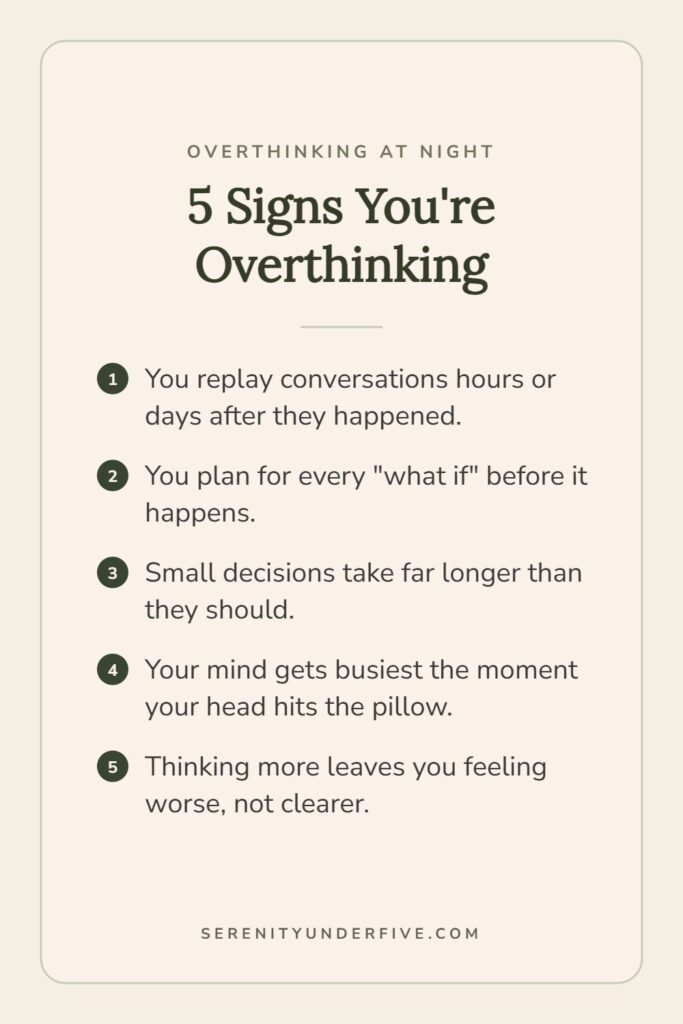
- You replay conversations hours or days after they happened.
- You plan for every “what if” before it happens.
- Small decisions take far longer than they should.
- Your mind gets busiest the moment your head hits the pillow.
- Thinking more leaves you feeling worse, not clearer.
If you recognized yourself in two or three of these, the steps below are a good place to start.
How to stop overthinking at night: 9 gentle steps
You don’t need to do all nine. Pick two or three that feel doable and try them for a week.
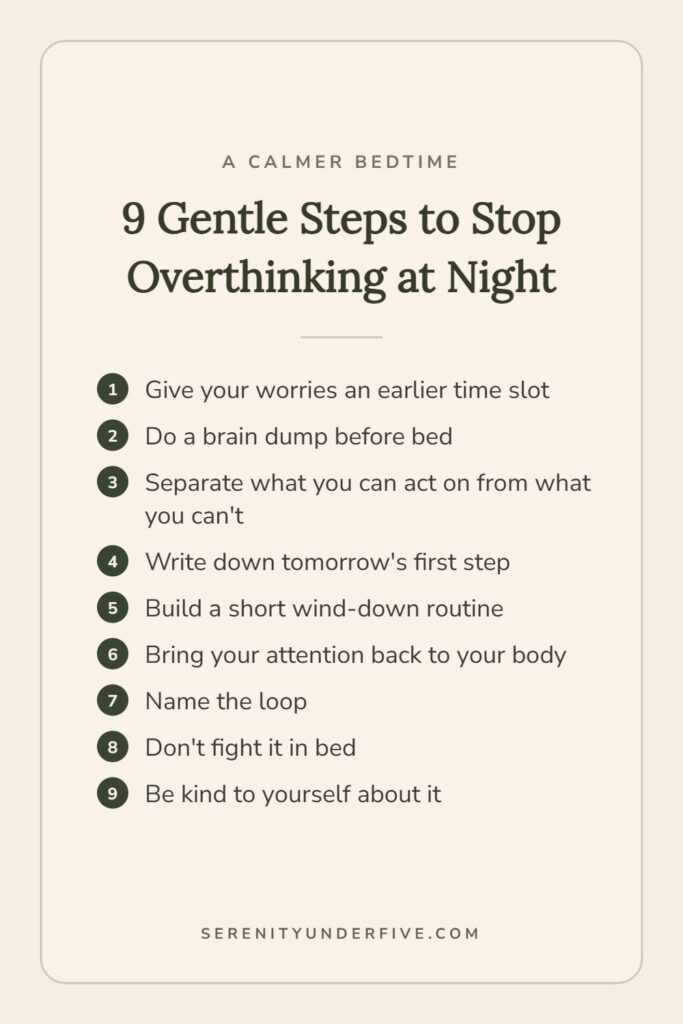
1. Give your worries an earlier time slot
Instead of letting worries show up at bedtime, give them an appointment earlier in the evening. Set aside 10 to 15 minutes, for example after dinner, to sit down and think through what’s on your mind on purpose. When a worry shows up later in bed, you can gently remind yourself: “I’ve already given this time today. I can come back to it tomorrow.”
2. Do a brain dump before bed
Take a piece of paper and write down everything that is taking up space in your head: tasks, worries, ideas, half-finished thoughts. Don’t organize it and don’t judge it. The goal is simply to move the thoughts from your head to the page, so your mind doesn’t feel it has to keep holding on to them.
3. Separate what you can act on from what you can’t
Look at your brain dump and sort it into two groups:
- Things I can do something about. Write the next small step next to each one.
- Things I can’t control right now. Acknowledge them, then let them sit on the page for tonight.
Overthinking often mixes these two groups together, which makes everything feel urgent and unsolvable at the same time.
4. Write down tomorrow’s first step
Many night-time thoughts are really your mind trying not to forget something. Write down the very first thing you’ll do tomorrow, even if it’s tiny (“Reply to Sam’s email”). It tells your brain the task is safely stored and it can stop rehearsing it.
5. Build a short wind-down routine
A predictable routine signals to your body that the day is ending. It can be simple: dim the lights, put your phone away from the bed, make a warm drink, read a few pages of a book. Doing the same few things in the same order each night makes them more effective over time.
6. Bring your attention back to your body
When your thoughts are racing, focusing on your senses can help you come back to the present moment. Two simple options:
- 5-4-3-2-1 grounding: notice 5 things you can see, 4 you can feel, 3 you can hear, 2 you can smell, and 1 you can taste.
- Longer exhales: breathe in slowly through your nose, then breathe out a little longer than you breathed in. Repeat for a few minutes.
7. Name the loop
Sometimes simply noticing what’s happening takes away some of its power. Try saying to yourself, “I’m overthinking again,” or “This is a ‘what if’ thought.” You’re not trying to argue with the thought, just to label it, so you can see it as a thought rather than a fact.
8. Don’t fight it in bed
If you’ve been lying awake for a long time and your mind won’t settle, it can help to get up for a little while. Go to another room, keep the lights low, and do something calm, like reading or writing in a journal, until you feel sleepy again. This stops your bed from becoming the place where you worry.
9. Be kind to yourself about it
Getting frustrated with yourself for overthinking usually adds one more thing to think about. Try speaking to yourself the way you’d speak to a friend: “It’s been a long day. It makes sense that my mind is busy. I’m doing my best.” Progress here is usually gradual, and every calmer night counts.
15 journal prompts for overthinking at night
Journaling is one of the simplest ways to get racing thoughts out of your head. Choose one or two prompts. There is no right or wrong way to answer.
Before bed: to clear your mind
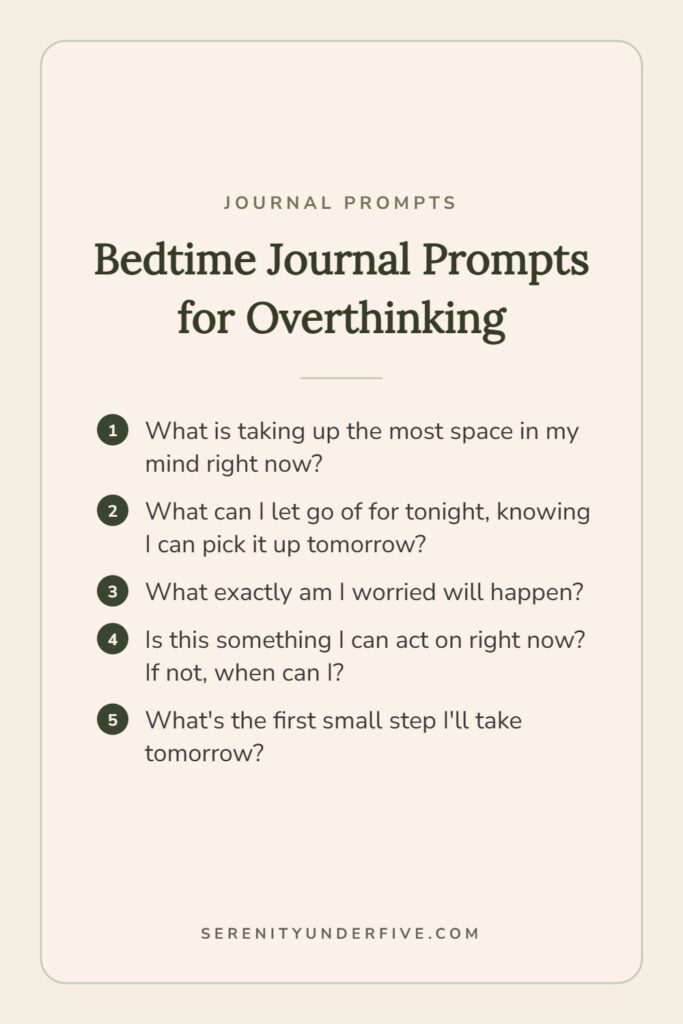
- What is taking up the most space in my mind right now?
- What happened today that I keep replaying, and what would I tell a friend who replayed it?
- What is one thing that went okay today, even if it was small?
- What can I let go of for tonight, knowing I can pick it up tomorrow if I need to?
- What’s the first small step I’ll take tomorrow?
When the thoughts start spinning: to slow the loop
- What exactly am I worried will happen?
- What evidence do I have that it will happen, and what evidence do I have that it might not?
- If the thing I’m worried about did happen, how would I cope with it?
- Is this something I can act on right now? If not, when can I?
- What would I think about this situation in one week? In one year?
For a gentler morning: to start fresh
- How did I sleep, and what helped or didn’t help last night?
- Which worry from last night feels smaller this morning?
- What do I need most today?
- What is one kind thing I can do for myself today?
- What would make tonight a little calmer than last night?
Free printable
The Bedtime Brain Dump
A 3-page printable to empty your mind before sleep: a brain dump page, a “sort it out” page, and 5 quiet-mind prompts. Enter your email and we’ll send it to you.
You’ll also get occasional gentle emails from Serenity Under Five. Unsubscribe anytime. Privacy policy
When to reach out for support
Overthinking at night is very common and often improves with small changes like the ones above. But if racing thoughts are keeping you awake most nights, affecting your daily life, or coming with feelings of hopelessness, please talk to a doctor, therapist, or another qualified professional. You don’t have to work through it alone.
If you are in crisis or having thoughts of harming yourself, contact your local emergency number or a crisis line right away. You can find helplines on our Disclaimer page.
Tools to help you go further
If you’d like more structure than a blank page, these printable tools were made for exactly this:
- Overthinking Workbook ($9.99): 30 guided worksheets to help you spot your triggers, challenge “what if” thinking, and build calmer daily habits, plus 10 bonus practice pages.
- 7-Day Mental Reset Journal ($4.99): about ten minutes a day of guided prompts, mood check-ins, and affirmations to clear mental clutter, one day at a time.
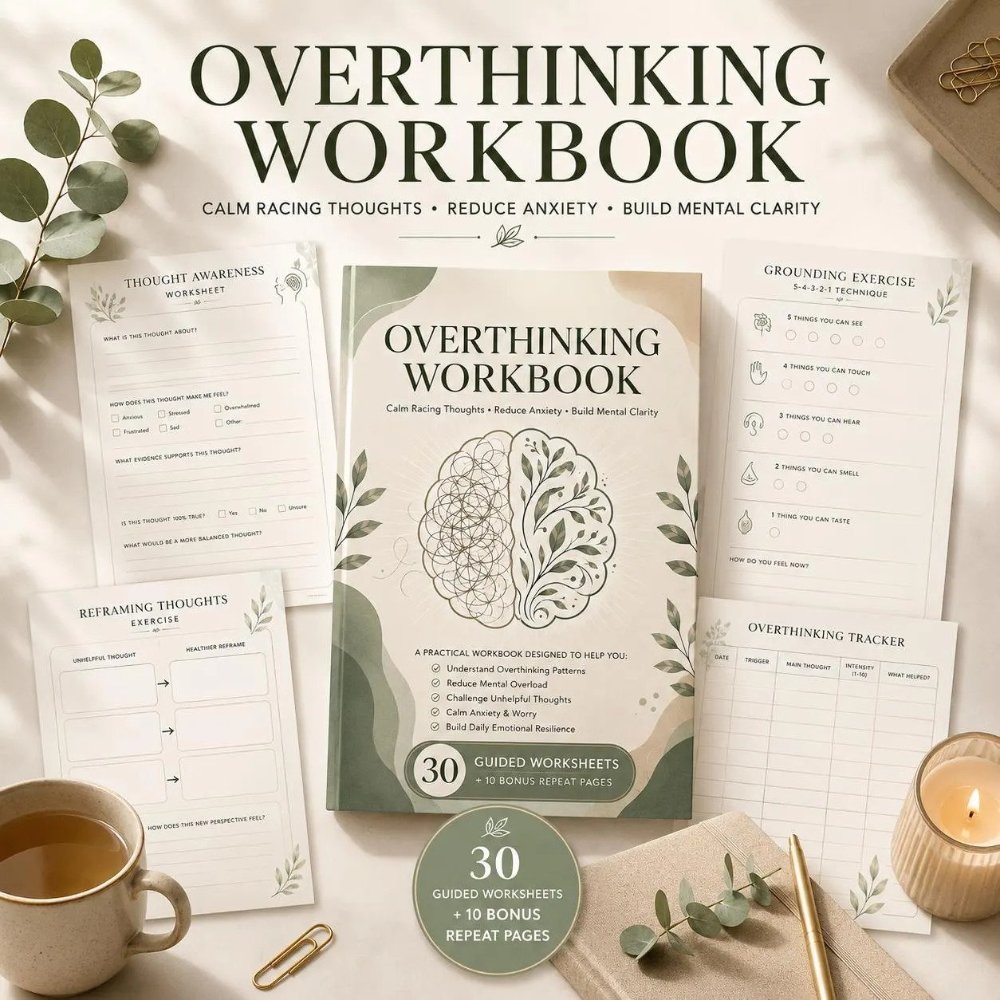

Both are instant downloads you can print at home or use on a tablet.
This article is for general educational purposes and is not a substitute for professional mental health care. See our full Disclaimer.